Peachtree City
Fayette Kept Its Tax Rates Flat: Why Peachtree City Tax Bills Can Still Go Up
By the Sharpsburg Realty Experts Media Team
Demo content: not for publication. The agent interviews, agent profiles, client stories, transactions and client reviews in this test article are fictional demo records. They don't describe real people, real sales or real testimonials. The tax, legislative and government information cited is real and linked to its sources.
Three local governments. Three unchanged tax rates. Three legal notices announcing a tax increase.
That's what Peachtree City homeowners saw this October from Fayette County, the city and the school board. If you're buying, selling or about to open a tax bill, it's fair to wonder which headline to believe.
Both are right. To show why, our media team went through the county, city and school district notices and the Nov. 3 ballot language, then talked it over with Morgan Bennett, our listing specialist who works with sellers across Peachtree City. Her one-line version: "A flat rate is not a promise of a flat bill."
If the rates didn't change, why is it called a tax increase?
Because property values went up, and Georgia law looks at revenue, not just the rate.
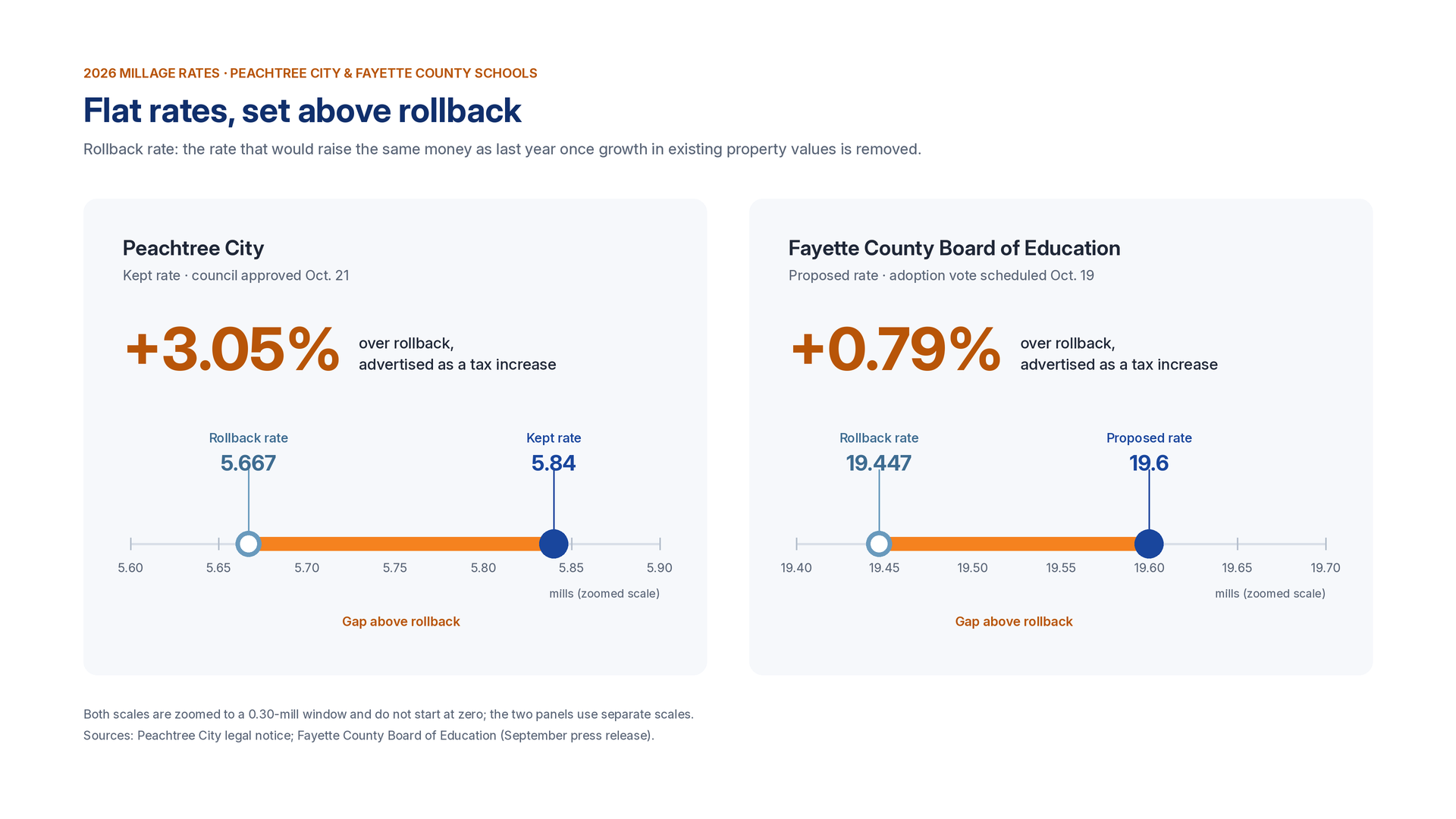
Each taxing body calculates a rollback rate: the rate that would raise the same money as last year from existing property, once growth in values is removed. Keeping a rate above rollback brings in more money, so it must be advertised as an increase.
Here's how that played out in 2026:
- Peachtree City kept 5.84 mills. The rollback rate was 5.667, so the city's legal notice calls it a 3.05% increase. The council approved the rate Oct. 21, according to a summary of the meeting.
- The Fayette County Board of Education proposed keeping 19.6 mills against a rollback rate of 19.447, a 0.79% increase, and scheduled its adoption vote for Oct. 19, according to its September press release.
- Fayette County commissioners unanimously kept the general fund rate at 3.763 mills Oct. 15, with no change to the separate fire, EMS and 911 rates.
"A government can leave the millage rate alone while a property's assessed value changes," Morgan said. "What matters to an owner is the actual bill after the applicable assessments and exemptions."
How much could my bill go up?
The official estimates are modest, but each one comes with caveats.
Each body published its own example, for its own sample home:
| Taxing body | Published increase over rollback | Example home |
|---|---|---|
| Fayette County (general fund) | $21.60 | $575,000 home, unincorporated |
| Peachtree City | about $34.60 | $500,000 home |
| School district | about $34.88 | $575,000 home |
Don't add those numbers up. They use different sample homes, the county's is unincorporated (no city taxes), and each shows only the increase over rollback, not a full bill.
The school and city lines matter most here. Together, they make up most of a Peachtree City homeowner's tax bill, and the school rate is more than three times the city's, Peachtree City Daily reported. The city's own finance memo says individual bills "will vary based on taxable value and applicable exemptions."
Morgan's reminder: "And an average increase in the news isn't an exact estimate for your house."
I'm buying in Peachtree City. Can I budget from the seller's tax bill?
It's a starting point, not the answer.
The seller's bill reflects the seller's situation. "Because the seller may have exemptions or an assessment history that doesn't match what the new owner will have," Morgan said. "And the purchase price itself doesn't automatically tell you the taxable value."
So when a buyer asks what to plug into a payment worksheet, we look at the property-specific record rather than a countywide percentage. We pull the latest assessment and tax information, flag the parts that depend on the current owner's exemptions, and separate the county, city and school lines instead of treating "property tax" as one number.
Then the right people fill in the rest:
- The Fayette County Tax Assessors handle property values, assessment notices and homestead exemption applications.
- The Tax Commissioner's office handles the tax bill itself, at (770) 461-3652. City taxes are included on the same county bill, so a Peachtree City owner gets one bill with separate lines.
- Your lender and closing professionals explain how taxes feed into your escrow and monthly payment.
Morgan's view: "I'd rather have the right official estimate, even if that means waiting for an answer."
Where do carrying-cost surprises actually show up?
Usually in an old number nobody rechecked.
"I don't have a specific transaction I could honestly say fell apart over a tax bill," Morgan said. What she does see is buyers and sellers reconciling different figures, like a listing that quotes the previous owner's taxes. "That is when we stop treating a listing field as a final answer and get the official information."
A related case came up this summer, and it was about HOA dues, not property taxes. Morgan's sellers listed a Peachtree City townhouse at $425,000 in early August and went under contract at $423,000 about nine days later.
An older data page showed monthly dues of $295. The current association documents showed $315, plus a separate one-time assessment of $2,400. The sellers paid the assessment before closing, and the sale closed Sept. 11, 2026.
Morgan shares that sale for what it teaches about carrying costs in general, not as evidence about Fayette taxes. "Its lesson is to verify carrying costs rather than trust an old number." Her advice to sellers in a similar spot: "Get the documents early. Don't rely on a five-year-old listing or a third-party website for the fee."
Is Peachtree City cheaper to own in than Sharpsburg or Newnan?
You can't tell from the millage rates alone.
Peachtree City is in Fayette County. Sharpsburg and Newnan are in Coweta County, so none of the Fayette rates, exemptions or ballot questions in this article apply there. And even between two counties, "you can't compare two millage rates in isolation and decide one house is cheaper to own," Morgan said. Assessments, exemptions, insurance and maintenance all vary.
So we put estimated housing costs side by side, verify taxes for each property, then weigh commute, location, layout and condition. "I'd never tell somebody to choose a county solely because a headline says its rate stayed steady."
What about the homestead exemption and the Nov. 3 ballot?
Keep two things separate: the exemption you file for, and the new ones on the ballot.
Your own homestead exemption. The seller's exemption doesn't follow the house to you, and closing doesn't enroll you. "Some buyers think signing the closing documents automatically enrolls them, and I don't want to give them that impression," Morgan said.
Fayette's basic exemption goes to owners who own and live in the home on Jan. 1, so a buyer closing this fall would be applying for 2027. For 2026 values, the Tax Assessors' deadline to apply or appeal was Aug. 7, so confirm the next deadline with the county.
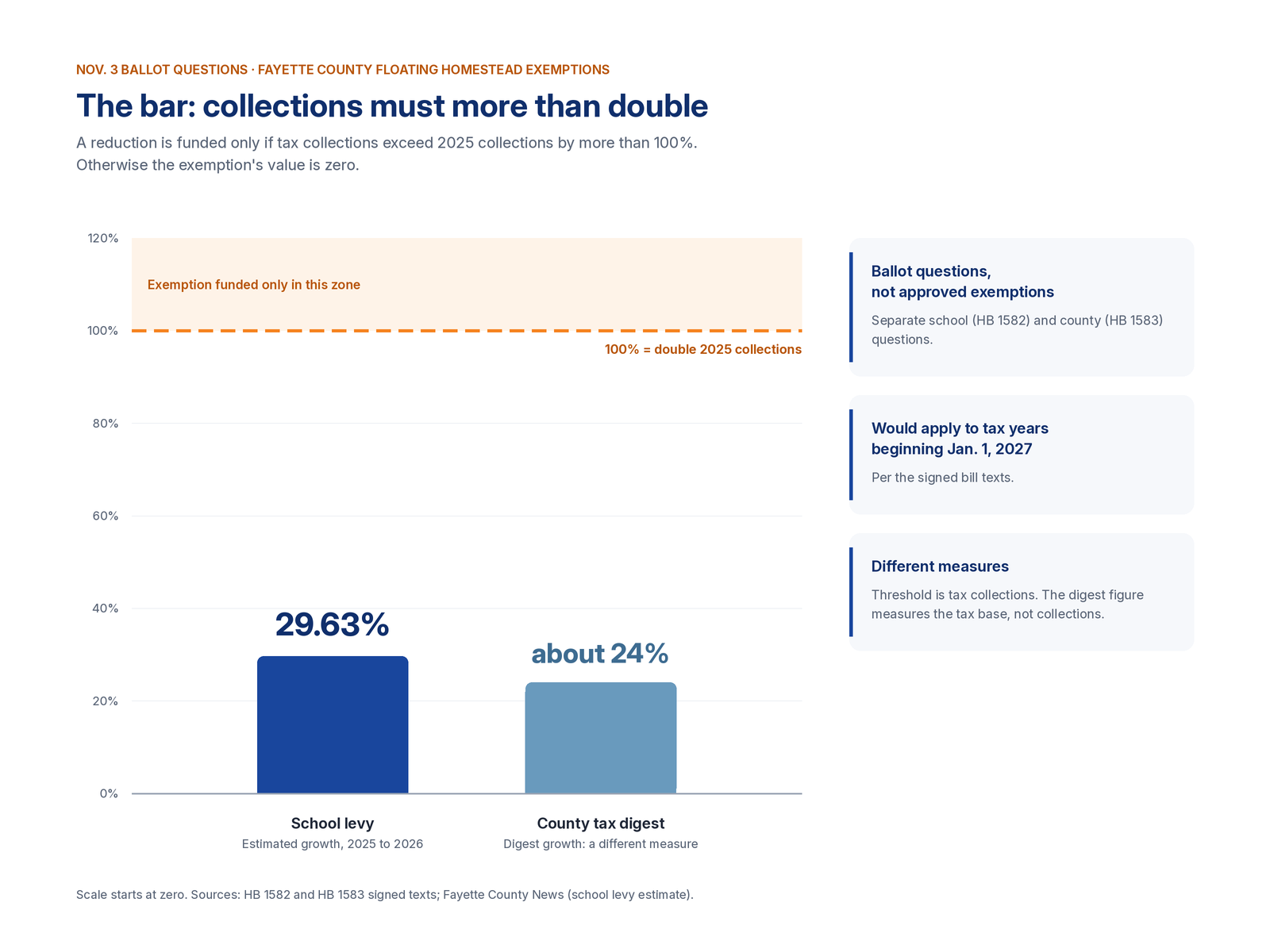
The ballot questions. Fayette voters will see two separate floating homestead exemption questions, one for school taxes and one for county taxes. Both are tied to how much tax collections grow beyond 2025 levels, and the signed texts of the school and county versions set the same bar:
- A reduction is funded only when collections exceed 2025 collections by more than 100%, meaning more than double. Otherwise the exemption's value is zero.
- Each would apply to tax years beginning Jan. 1, 2027.
- The school version covers only school taxes, and owners must file an application for it. Neither covers city taxes.
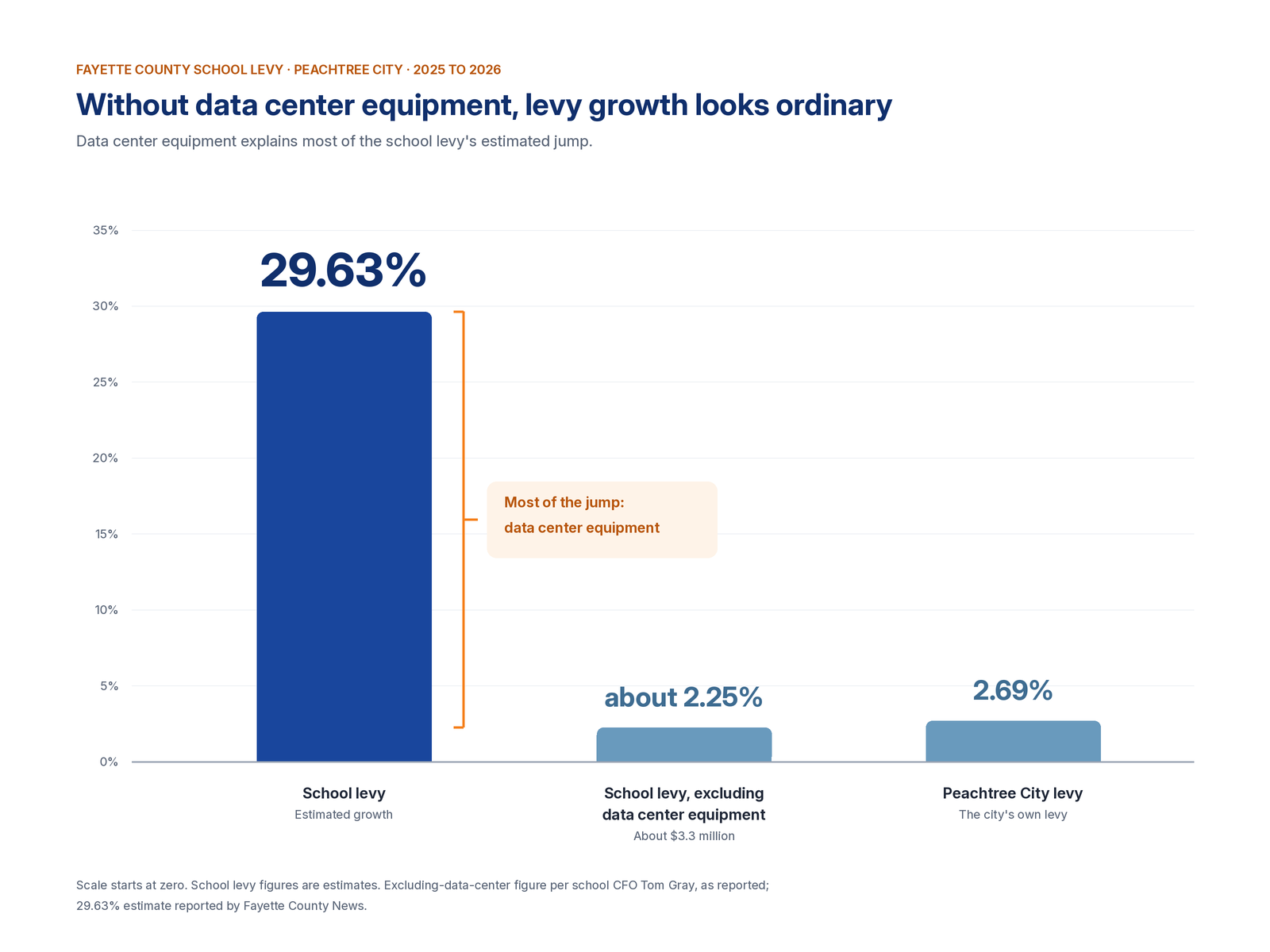
For scale, the school levy is estimated to grow 29.63% from 2025 to 2026, Fayette County News reported, and the county's tax digest grew about 24%. Both are far short of doubling.
These wouldn't be Fayette's first floating exemptions. Voters approved one for school taxes in 2020 and the statewide HB 581 exemption in 2024, according to the Tax Assessors' office. The Nov. 3 questions would add new ones on top.
Morgan's budgeting rule: "That's not something I'd count in a payment until the measure has actually passed and the county explains its effect." Early voting runs through Friday, Oct. 30.
I'm selling. How should I handle buyers' tax questions?
Share what you know, label it clearly, and leave projections to the professionals.
Morgan advises sellers to share the existing assessment and bill, and say what year they cover. "Don't advertise the seller's tax amount as the buyer's guaranteed future tax," she said. Point buyers to the official records and let their lender estimate the payment.
And don't let the news drive your price. "I also remind sellers that a tax headline doesn't settle their home's market value." We price from comparable sales, condition and current activity.
My bill went up more than I expected. What now?
Start by finding out which part changed.
Read the bill with your assessment notice. "Which taxing authority changed the amount?" Morgan asks. Did your assessed value change, or did an exemption drop off? If something looks wrong, contact the right county office promptly. "There may be an assessment-appeal process, but I wouldn't guess at someone's eligibility or deadline."
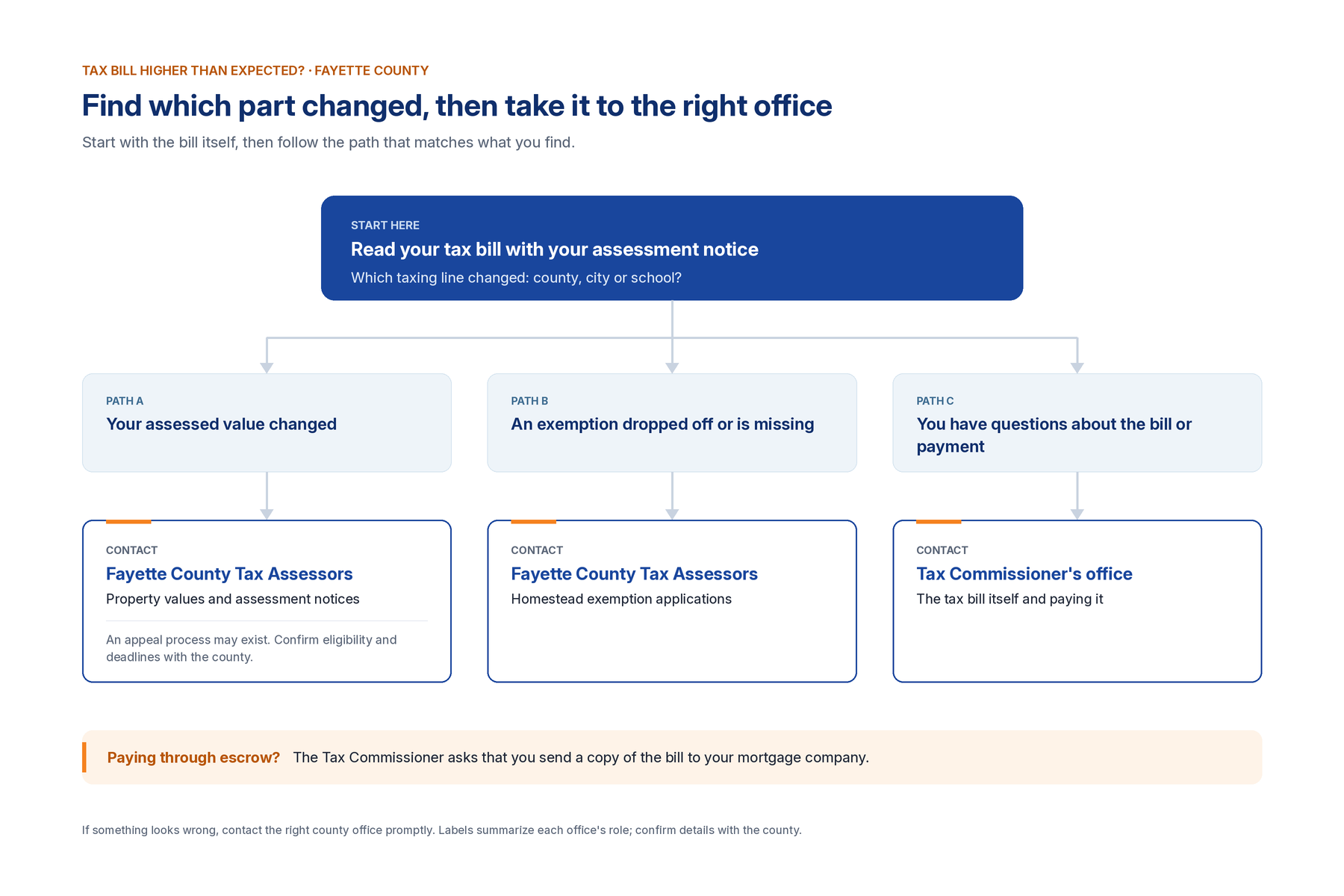
Timing matters, too. As of Oct. 26, the Tax Assessors' site said 2026 bills hadn't gone out yet. Bills are due 60 days after mailing and become delinquent after Nov. 15 or 60 days after mailing, whichever is later. If your taxes are paid through escrow, the Tax Commissioner asks that you send a copy of the bill to your mortgage company.
One more piece of context: why did the countywide tax base grow so much? Largely because of data center equipment. The school levy's estimated 29.63% jump drops to "about $3.3 million, or 2.25 percent" without it, according to school CFO Tom Gray. Peachtree City's own levy grew 2.69%.
Key takeaways
- A flat rate isn't a flat bill. Keeping a rate above rollback must be advertised as an increase.
- Published estimates are examples, not your bill.
- Buyers: budget from official, property-specific numbers, not the seller's bill.
- File your own homestead exemption after you buy.
- Don't budget for the Nov. 3 floating exemptions. They pay off only if collections more than double from 2025.
- Surprised by a bill? Find which line changed and contact the county promptly.
Recent Transactions From Our Team
Our agents work with buyers and sellers across Peachtree City and nearby Coweta County, from extra showings and honest disclosures to keeping contingencies and closing dates on track. Here are a few of our recent local closings, along with feedback from the clients we helped.
Peachtree City
[DEMO] 1619 Demo Cedarlanding Bend, Peachtree City Listed: $548,000 · Sold: $543,000 · Closed: Oct. 6, 2026
"She helped us arrange additional visits so we could listen from different parts of the property and make our own decision." — Robin Hughes
Sharpsburg
[DEMO] 1417 Demo Summerbranch Drive, Sharpsburg Listed: $475,000 · Sold: $470,000 · Closed: Sept. 18, 2026
"It felt better to be straightforward with buyers than to create confusion later." — Ellis Woods
[DEMO] 1013 Demo Pinebasket Court, Sharpsburg Listed: $499,000 · Sold: $495,000 · Closed: Aug. 21, 2026
"Morgan helped keep track of the buyer's home-sale contingency and the various closing dates." — Jamie Rivers
Newnan
[DEMO] 303 Demo Lantern Walk, Newnan Listed: $389,000 · Sold: $382,000 · Closed: Oct. 6, 2026
"He also encouraged us to compare the houses themselves, not just the financing headline." — Taylor Bennett
Meet our team
Morgan Bennett, our listing specialist, helps Peachtree City sellers price, prepare and document their homes. Avery Collins guides buyers through showings and offers. Caleb Brooks helps Coweta buyers compare resales and new construction.
Buying or selling in Peachtree City and want a clear picture of carrying costs? We'd be glad to help. Reach out to our team at Sharpsburg Realty Experts, and we'll help you find the right official records and questions to ask, and connect the numbers to your plans.